

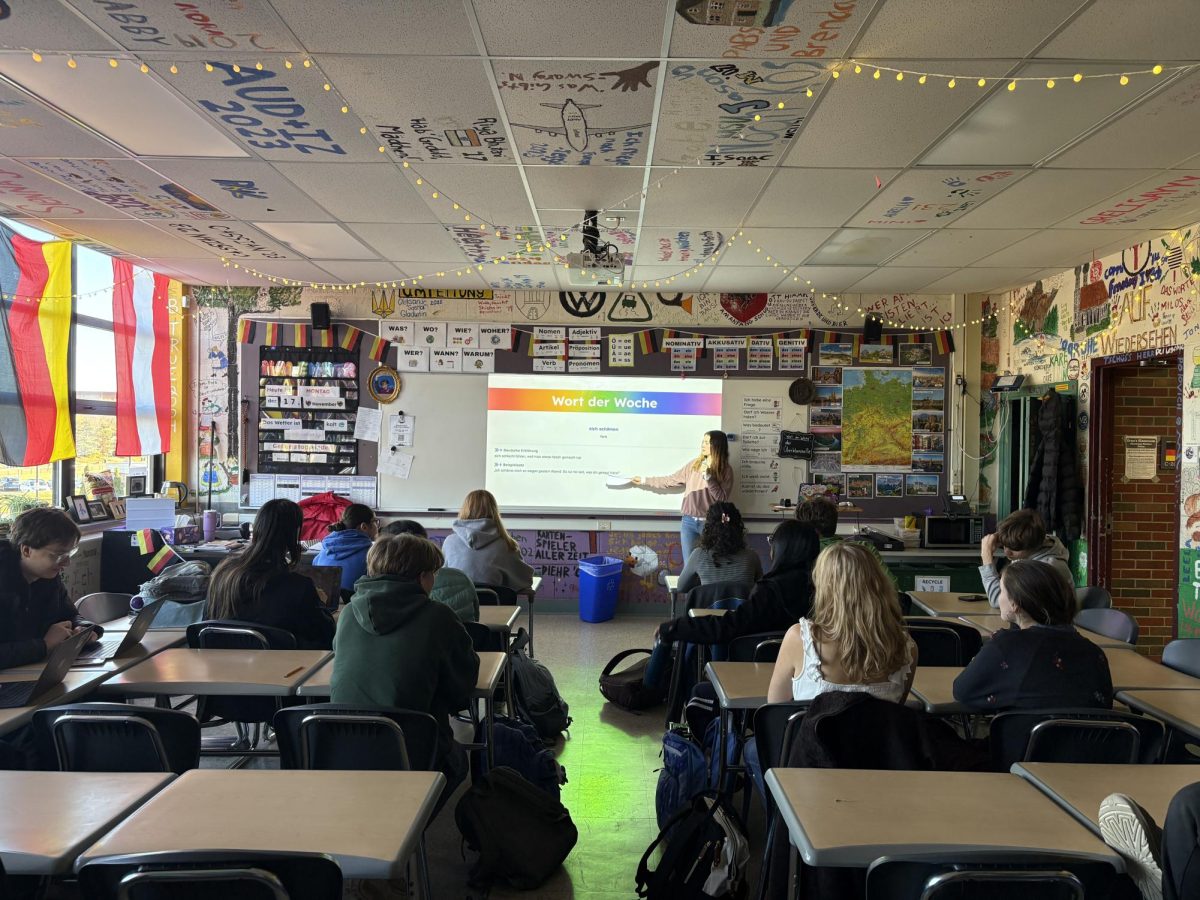
The first day of school in the 2025-26 academic year was filled with confusion as Pioneer students walked into some classrooms to find peers taking a completely different course sitting at the same table. Some of these instances were common scheduling errors, but most came with a new district emphasis: combined sections.
As a result, classes such as German IV and AP German, as well as all sections of Latin, have been combined into one hour to accommodate for a smaller faculty body and fewer hours in the schedule for elective courses. This has put a strain on some teachers’ ability to focus properly on their students and their curriculum.
Pioneer Principal Desmond Smith says that the new class style comes from changes to budgeting on the district level, including a new minimum 18-student requirement for all classes — at Pioneer anyway. “We had staffing meetings all spring and summer with our bosses at central office,” says Smith, “and they kept looking at our numbers for enrollment and how many students were scheduled in each section, and if it didn’t hit that 18 mark, then they told us to either cut it or combine it with something. So we’re trying to save some classes by combining, (but) some got cut.”
Despite this, Smith wants to keep as many elective options as possible for the students to choose from, including the AP German class. “We had to do two different combined classes,” he says. “That way we are able to run the AP class, because all the students wouldn’t be able to take the class if it was in only one hour.”
Combining sections is “less than ideal” for German teacher Anna Craigmile. “It limits my flexibility as to what I can do,” she says, “and it adds a lot of prep time in order to make sure that everyone has the space that they need to do what they need.”
This has also made focusing on course material difficult for students. Pioneer senior Avery Samford says of AP German, “I think that the class would be a lot more productive if we had more time to work with and get to know the teacher which is lost when we have to split her with another class.”
Craigmile says the cause of combined sections and oversized classes is the district’s unwillingness to hire new faculty. “They should figure out how to shake loose some dollars to make sure that we can have class sizes that are conducive to learning,” she says. “We pride ourselves on being a good school district, a school district that people want to come to, but we don’t put our money where our mouth is.”
Smith adds that this has been a particularly extreme year of teachers leaving Pioneer, contributing to the strain on those that stayed. “We have seven or eight teachers that retired last year. Some people we knew about, some we did not,” he said.
Additionally, he says, teachers were poached by other districts offering higher salaries. “In Ann Arbor, there’s only a certain amount of money you can make, and when people dangle an additional $30,000 to $50,000, why wouldn’t you go?” Smith says. “They didn’t want to leave. But when you get pursued the way they were pursued, it’s hard to say no, especially when you work less and you make more money.”
Smith hopes all the teachers that left have a good time at their future jobs but worries about replacing them because experience can only come with time. “Sometimes all you can say is, ‘Thank you for the time that you gave us’ and hope for the best. With Sarah Roldán, Amy Van Appledorn, and folks like that (leaving), people expect the same or better to be filled following that person, which is practically impossible. So we just have to give the new person time and a little grace to make their own footprint.”